
Without the Apollo guidance computer we would not have gotten to the moon and back. Today It might be vastly out gunned by a simple smartphone but that’s not the point, it was made to do a job and the way it did it influenced computers for decades to come.
It was the first computer to be used in a mission-critical role where people’s live were on the line, if the hardware or software failed, then so would the mission and the crew would be lost.
There is a common misconception that when the AGC became overloaded with information from the rendezvous radar when it was accidentally left on during the descent and caused the 1202 alarm, that Armstrong took control and landed the lunar lander by hand.
In fact, the system was a fly-by-wire, everything the crew did went through the computer, there was no manual override, the landing was autonomous, and it would have landed anyway, but it may have been in the middle of a boulder field, that’s what Armstrong saw and guided the lander to a clear spot.
The AGC was one of the first examples of space computers, systems that were built for the rigours of space and with reliability as its top priority, where there would be no second chances and no one would be coming out to fix it if it went wrong.
Since then, we have sent space probes to all the planets and beyond, landers and rovers to the moon, mars and Venus and even landed on asteroids and comets and the vast majority have performed their mission to completion with many having gone well beyond their design life and at the heart of all of them are computers, some like the voyager probes are now over 46 years old and still working.
So, what is so different about space computers to the ones we use here on earth?
Well the main difference between using a computer on earth and in space is the environment, not so much for temperature although that will have a bearing as it can be a much wider range in space, but the radiation which any computer system will be exposed to when it is outside of the protective atmosphere of earth or high in the Earth’s atmosphere where there is more exposure to radiation from the sun and outer space.
The Radiation effects on computers can be anything a minor glitch that might not even be noticed to the blue screen of death and permanent damage making it unusable, depending upon where a charge particle might actually hit in the computer or its memory and how much energy the particle was carrying.
Although we had sent computers to the moon and into space in the 1960s, it was only in the late 1970s that radiation was found to be causing issues within memory chips. In 1978, IBM received reports that some of its 16 KB DRAM chips were randomly flipping bits with no apparent explanation.
After an investigation, it was found that the ceramic casing in which the memory chips were encased, had become contaminated with very small amounts of uranium from an old uranium mill further up the Green River in Colorado, where the ceramic casing material came from.
By this time the miniaturisation of the MOSFETs which made-up the DRAM was small enough so that a single alpha particle emitted from the uranium, could create electron hole pairs in the silicon and release enough free charge carriers to fill up the semiconductor well, the part of the chip that that determined if the memory bit was set to a one or zero, this could then flip a one to a zero.
This type of data corruption is called a Single Upset Event or Soft Error and doesn’t cause any permanent damage, the bit can be flipped back again, but if that bit controlled an essential part of a system, such as turning on or off a thruster or reporting a critical piece of information, then the result could have a very real and drastic and possibly mission ending effect out in space.
However, in space, there can be much more damaging cosmic rays, which are not actually rays but particles made from the nuclei of atoms stripped of their electron shells and fired out from supernovas and black holes, travelling at close to the speed of light. These can be nuclei’s of hydrogen, helium and the heaviest and most damaging iron, and if they hit a spacecraft can easily rip through its outer shielding and shower the interior with secondary radiation, including secondary electrons, bremsstrahlung (X-rays), and in some cases, gamma rays or even neutrons.
If they hit a chip, they can cause much more damage by turning parasitic transistors that exist near the N-P junctions that will stay on until the power is removed or the device burns out. They can also cause gate rupture or dielectric rupture. Any of these can cause the device to fail and compromise the mission.
Both Voyager probes have been hit by suspected cosmic rays, leading to Voyager 2 sending back gibberish in 2010 and Voyager 1 going silent for 5 months more recently.
If this were to happen on earth, at least the affected part could be replaced, but out in space, no one will be coming to fix it.
So over the years, error correction has been built into space-faring computers, this is also available on earth in things like ECC memory, or Error Correcting Code memory.
This is a type of RAM that detects and corrects single-bit memory errors. It adds extra bits to each data piece stored in memory, allowing the system to identify and fix errors caused by interference, radiation, or other factors.
But what about the CPU and other parts of the data processing?, Well, here methods like Triple modular redundancy can be applied.
Here, one single data input is fed into 3 identical logic circuits and the outputs are compared to each other. If one of them is different, because of an error, that one is downvoted, and the other two identical outputs are combined and used.
This was expanded in the Space Shuttle. It used 4 identical computers, all running the same code and in lock step. Every 3 to 4 milliseconds, the output from each computer was compared to the others and if there was a disagreement in the data, the majority vote would win, and the computer with the failed result would be deselected.
A fifth backup computer ran alongside them with different software, and if all four primary computers failed, the fifth one would take over the task. In all the missions of the Space Shuttle, the fifth backup computer was never used.
But, it’s probably better to try an avoid the error from occurring in the first place than fix it later, so the components in spacecraft are radiation hardened. In the case of memory chips and CPUs this includes using insulating substrates like Silicon-on-Insulator or Silicon-on-Sapphire.
Wide band gap semiconductors are also now being explored like Gallium Nitride and Silicon Carbide for radiation-hardened components.
Spot shielding of chips can be used to stop radiation from reaching the die, this can include depleted boron to reduce neutron radiation.
But building with the triple modular redundancy increases the area size of the die for no extra performance.
The priority here is reliability above all else, including speed and computing power. This meant that computer systems built for space were one-off devices and very expensive to develop, and they were never made in quantity and lagged well behind their commercial counterparts in capability and performance.
So, trying to keep a cap on the costs and reap some of the benefits from the rapidly evolving CPU development, NASA set out to use radiation-hardened versions of commercial-off-the-shelf components.
The first of these to be developed was the RAD6000, a radiation harden version the IBM RISC single chip CPU in 1995. This was superseded in 2001 by the RAD750 based on the PowerPC 750 manufactured by IBM and Motorola and which would be software compatible with the commercial version that was used in the Apple Power Macintosh, later the Power Mac,.
The RAD750 used 250 to 150mn process with a clock speed of 110 to 200MHz and could withstand 1 million RADs exposure while the complete system with motherboard, can withstand 100,000 RADs.
Up until a few years ago, nearly all the major space projects, including the Curiosity and Perseverance Mars rovers and the James Webb Telescope, used the RAD750, which is now almost a 25-year-old design. This meant that tasks that would be easy for a modern CPU to handle like real time hazard avoidance for the Mars rovers, would be too much for the aging RAD750.
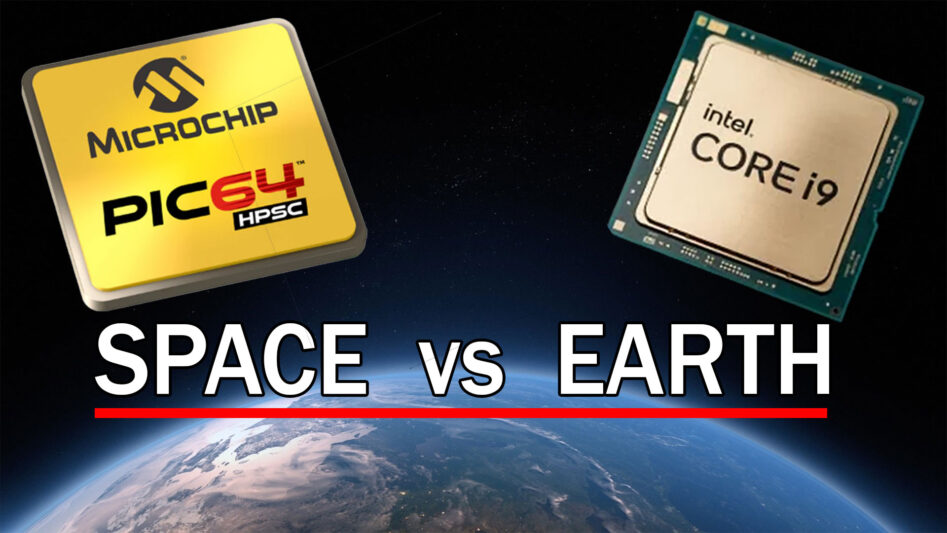
In 2022 NASA announced that it had selected Microchip to develop a High-Performance Spaceflight CPU that could provide at least 100 times the computational capacity of current spaceflight computers with extremely low-power consumption while withstanding harsh space conditions
The Radiation-Hardened PIC64-HPSC RH has eight RISC-5 cores and a clock speed of upto 1GHz as well as optional dual-core lockstep operation, similar to that used by the Space shuttle but on processor cores rather than complete computers, and can withstand 100,000 RADs exposure. It is constructed on a 12nm process using advanced FINFET materials and structures specifically designed and tested to resist Total Ionizing Dose radiation damage.
The chip is designed to give autonomous missions the local processing power to execute real-time tasks using AI for things like rover hazard avoidance on the Moon’s surface, something which on the Mars rovers had to be preplanned and sent to the rovers as a set of manoeuvres to perform but could not react in realtime to a rapidly changing mission condition.
Software is another area where spaceflight computers vary from your average PC. Here, Real-time Operating Systems (RTOS) such as VxWorks are used with deterministic performance. These can guarantee how long a process will take to execute, down to the microsecond. This is something which is extremely important when changing course in space and requires precisely timed thruster and engine burns to accurately place the spacecraft in orbit or perform gravitational sling shots around a planet for deep space missions.
So while todays space based computers might well lack the raw performance of the latest Earth-based CPU’s, like the Apollo Guidance computer of nearly 60 years ago they are here to do specific jobs in the most efficient, reliable and cost effective ways possible in the harsh environment of space.
So, I hope you enjoyed the video and if you did then please thumbs up, share and subscribe and thanks go to all our patreons for their ongoing support.
