
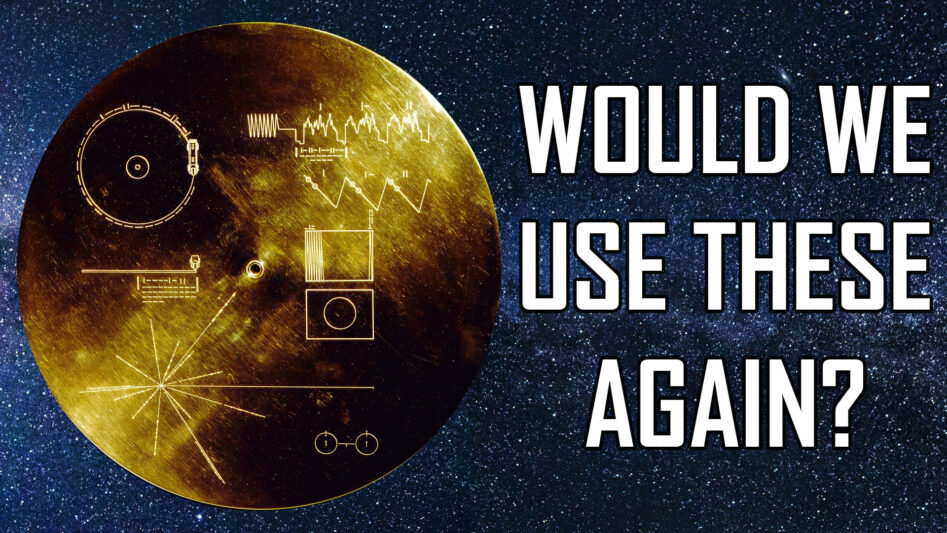
On the 20th of August 1977, Voyager 2 was launched, then on the 5th of September 1977 Voyager 1 was launched.
Their mission would take advantage of a favourable planetary alignment to explore Jupiter and Saturn, then during the mission the destination was changed so that Voyager 2 would fly on to Uranus and Neptune and Voyager 1 would fly past Saturn’s moon Titan and put it on a trajectory out of the plane of the solar system and into interstellar space.
Once Voyager 2 had flown by Uranus and Neptune, it too would be on a one-way ticket out of the solar system.
But this wasn’t the first time that spacecraft had been deliberately sent on such trajectories.
The earlier Pioneer programme of 1972 and 73 sent space probes Pioneer 10 and 11 also to explore Jupiter and then Saturn before travelling out of the solar system.
Both of these spacecraft carried a small metal plaque identifying their name and place of origin for the benefit of any other spacefarers that might find them.
So, with the Voyager probes, it was thought that it would be a good idea to put a more ambitious message aboard Voyager 1 and 2, in essence a time capsule that would carry a story of our world to any extraterrestrial space farers that might find either of the probes in the distant future.
Now, some say that we shouldn’t give away our location and details about ourselves to possibly hostile aliens, but you have to remember that the Voyager probes are travelling very slowly compared to the speed of light. It would take between 77,000 and 84,000 years, because Voyager 1 is travelling a little bit faster than Voyager 2, for the voyagers to reach the nearest star Proxima Centauri, which is only 4.2 light years away.
But they aren’t going towards Proxima Centauri, it will take about 20,000 years for them just to pass through the Oort cloud, which is a shell of icy bodies that surrounds the solar system that contains possibly trillions of bits ice and rock that is considered by some to be the true edge of the solar system and once it has left this, it will feel the gravitalional effect of other stars more strongly than our sun.
20,000 years is a very long time for modern humans, go back 20,000 years and we were in the mid-stone age. Considering the exponential growth in technology in the last 200 years since the beginning of the industrial revolution, and provided that we avoid self-inflicted and natural disasters, 20,000 years in the future we could be very different to how we are now and may well have become a space-faring species ourselves. Basically, if Aliens were to find the Voyagers in our lifetimes, then they are already here in our solar system.
And this is what many fail to comprehend about the huge amount of time that lies ahead of the Voyager, Pioneer and New Horizons probes, their futures stretch in the billions of years, beyond that of the lifetime of the Earth, let alone any life that may be on it.
So what about the Golden Records that are fixed to the sides of the Voyagers.
The idea of the Golden Record was thought up at the time by Carl Sagan and his wife Ann Druyan (Driyan). Others, including Frank Drake, Jon Lomberg, and in collaboration with NASA helped in assembling the 115 images and a variety of natural sounds, musical pieces and greetings in 55 languages and printed messages from President Carter and U.N. Secretary General Waldheim.
It would include not only pictograms but also sounds and images. These would be encoded onto the disc as an analogue waveform, and the disc was mounted on the outer body of the space probe. The images are scanned like the old style CRT TV’s and encoded in analogue form and composed of 512 vertical lines.
What we have to bear in mind it that this was the late 1970s and the methods for encoding data on to an object which was expected to remain in space for anything up to 10s of billions of years or more was very limited, but they realised that a phonograph record was the most efficient means of compressing the variety of data in to a single space, so using a metal copy of a vinyl disc seemed the best way to produce it.
Due to the popularity of the Pioneer plaques, which were also created by Sagen and Drake, it was thought that that Golden Record would also be a good PR for the unmanned mission.
But if we were to launch another space probe today called for example voyager 3 to follow on behind, would we still use a golden record to tell the story of humans and the planet they lived on, or with the advancements in technology since the 1970s would we use another form of media to hold the information?.
But let’s look again at the golden record because although it was very similar to the vinyl records found here on earth, and that you and I used to play our music back on, there were some major differences.
Firstly, the most obviously was that it was not made from vinyl, it was not a gold plated vinyl record, it was actually a gold-plated copper record, and it can be played, so it’s not just for show and even comes with its own stylus.
Although it can be played, it won’t play correctly on a traditional record deck because to pack in all the audio information and images on the record as an analogue signal, its design speed it is 16 – 2⁄3 rpm instead of the normal 33 rpm, so you would need a custom speed controller to play it here on earth, and there are 12 copies of the record, two in space and the rest in various NASA centres.
Even though many people think there is nothing in space, there is interstellar dust and at the speed that the voyagers are travelling at, between 56,000 to 61,000 km/h, each tiny impact damages the record, not to mention, charged particles from our sun in the solar wind and much more damaging cosmic rays from objects like supernovas and blackholes in the milky way. Each time they hit the record, they can knock atoms out of the crystalline structure of the metal, weakening it over time.
It’s a bit like being sandblasted but with atomic nuclei, and over enough time, probably billions of years, it will wear the metal down in a similar way.
So, to combat this, they made a cover to protect the record and also to act as an infographic to show where the probe comes but how to play the record with the supplied stylus and the correct speed at which it should be played.
This cover is made from aluminium plated with an ultra-pure sample of uranium-238. The reason for this is twofold, firstly, uranium is very dense and blocks x rays, gamma rays and cosmic rays about five times more effectively than lead and secondly, any advanced civilisation that may find the voyagers could use the ratio of remaining uranium to the other elements to determine the age of the record and voyager.
There will also be a subtle difference in how the two voyagers are affected by the course that they are on. To find out how much their different courses will affect the lifetime of the records, Nick Oberg, at the Kapteyn Astronomical Institute in the Netherlands, and a colleague calculated which (if any) stars the two Voyager spacecraft may encounter in the long future of our galaxy.
It will be 30,000 years by the time they pass by Ross 248, a red dwarf. But it will be 500 million years by the time they have completed one orbit of the Milky Way, and during the trip they will oscillate above and below the plane of the galaxy with Voyager 1’s up and down path being more than Voyager 2.
Oberg calculated that during this time each of the space probes would pass within 150 AU or about 3 times the distance of the sun to pluto, of at least one star.
This will take it in the areas where there is much more intergalactic dust, and the density of the stars it will see will be about half, which means that Voyager 2 cover will likely remain legible but Voyager 1’s might be eroded.
Both records are calculated to last 5 billion years, but by then they will be caught up in the merger of the Milky Way and the Andromeda galaxy. From there on Oberg’s computer models show that there is a 1 in 5 chance that they could kicked out of the new galaxy into the galactic neighbourhood. Here, high-energy cosmic rays pose the biggest danger, but they could then float on through intergalactic space away from the stars for trillions and trillions of years, free of main sequence stars and populated by only white dwarfs, dead stellar cores, black holes and neutron stars.
But what if we sent a new voyager with modern storage. The most resilient data storage we have yet developed is fused quartz, in which data is written with femtosecond laser on the nanoscale. 12 cm discs using this method can store upto 360 terabytes of data and these could last for at least 14 billion years.
But the problem with these is, you need highly sophisticated technology to be able to read the data stored using two optical dimensions and three spatial co-ordinates that are written throughout the quartz disc at nanometer dimensions.
That would take a whole lot more explaining than the cover of the Voyager records would allow, and any kind of electronic reader that was sent along with it would decay away long before the quartz discs, which kind of defeats the whole object of the exercise to be able to show who we were, were we came from and what we were like in a simplest, easy to understand form.
So maybe, in a strangely futuristic retro way, the 1970s tech of a metal version of a vinyl record might well be the best thing we could send out into the universe now to say, yes we did exist.
So, thanks for watching and if you enjoyed the video them please thumbs up, share and subscribe and a big thanks go to our patreon for their on going support.
