
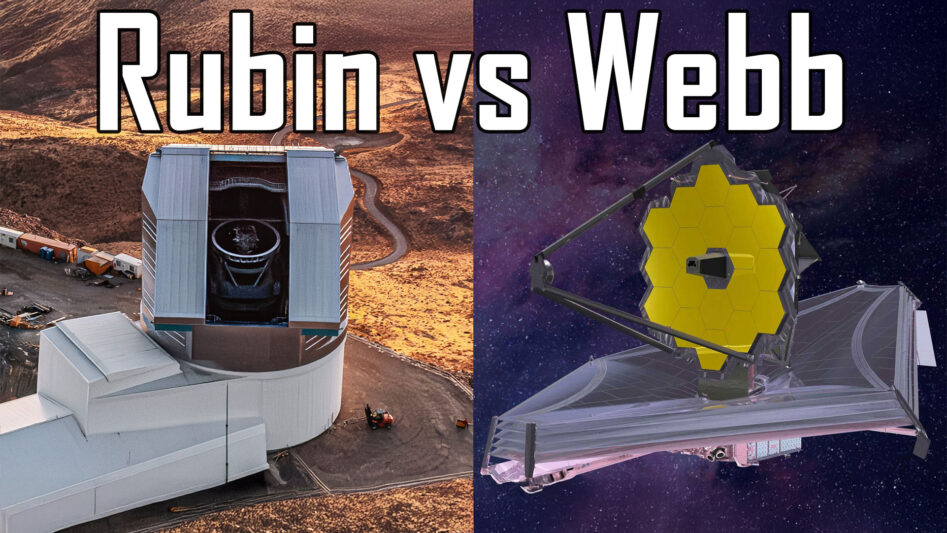
First there was Hubble, the telescope that literally brought us images from almost the beginning of the universe as we know it, with unbelievable visions of the most distant objects we have ever seen.
Then came the James Webb telescope, this was like Hubble on steroids and has gone even farther back into the history of the universe and has shown us things which we still don’t understand and threatens to upend our theories on how stars and galaxies first formed.
Then, in the last week, we have the Vera Rubin observatory releasing its first images, which cover a huge amount of the night sky in ways we’ve never really seen before.
So why do we need so many different ways of looking at the same thing, basically the night sky and the stars and galaxies that exist out there in the universe?
In this video, I thought I’d look at the differences between the James Webb telescope and the Vera Rubin telescope and why the two really do go hand in hand.
Now just in case you haven’t been following the developments in space for the last few years or more, the James Webb Space Telescope was launched to stand on the shoulders of the Hubble Space Telescope and see fainter objects that go deeper back in time than it’s ever been possible before, by looking at small patches of the sky with probably the most sensitive piece of optical equipment anyone has yet built.
The light it looks for has travelled so far, for so long that it has been red shifted from visible light into the infrared spectrum, which we feel as heat and to be able to detect it, the JWST camera sensors needed as cold as possible and work at just 7° Kelvin above absolute zero.
This meant that it couldn’t be in a low Earth orbit like the Hubble, as the infrared heat from the Earth and the constant heating and cooling going from full sun to full shade as it orbits the earth would swamp out the infrared signals coming from the edge of the visible universe.
So, it’s in a special orbit near the second Sun-Earth Lagrange point (L2), which lies approximately 1.5 million kilometres (1 million miles) from Earth on the far side of Earth from the Sun, where the gravitational forces of the Earth, Sun and Moon and the orbital motion of the JWST balance each other it hovers there without being in an orbit.
Here, with the large multi-layer heat shield that protects it from the sun and with cryogenic cooling equipment, the JWST can reach it’s 7° Kelvin target.
Web’s first deep field image was taken with the Near-Infrared Camera and showed thousands of galaxies, including the faintest objects ever observed at the time in the infrared spectrum in an area of the sky that would be about the size of a grain of sand held at arm’s length, You could fit about 600 of these images into the area the size of your thumbnail held at arm’s length. This was a composite image made of images at different wavelength and total exposure time of 12.5 hours.
And this is what the James Webb specialises in, looking at an incredibly small piece of sky which to us here on earth would look like it was completely empty and yet we have found contains thousands of galaxies going back to just after the big bang in these tiny patches of apparent nothingness.
But If we wanted to survey the entire sky using the JWST taking similar sized images but with a much faster exposure time you would need over 25 million such images. Even if you took one image every minute, it will take you over 47 years to image the entire sky once, clearly something which is just not practical.
And this is where the Vera Rubin observatory comes in, it is designed to take images of the entire southern night sky in just a few days, and it does this here on Earth looking through our atmosphere from a location at an altitude of 8770ft or 2672m in the Coquimbo Region, in northern Chile, along side other large optical telescopes.
Now you might say, Why do we want to take continuous pictures of the sky, Well if we do this we can see the universe in motion over time and how things change over a matter of hours or days and eventually years.
Many astronomical phenomena are short-lived, like supernovae, gamma-ray bursts, novae, or gravitational wave counterparts. Rubin will take images in quick succession over a 10 year and now possible 12 year predicted period, allowing us to capture things within maybe minutes or hours of them happening and have a record of what happened before as well as after the event.
Ruben will see much more than distant events, it will become the most effective tool for finding and tracking potentially hazardous asteroids and measuring their motion speed and orbit to see if they would become earth impact events.
In fact within just 10 hours observing the night sky, Ruben had already found more than 2000 new asteroids including a few near earth objects.
The Rubin observatory will also carry on the work of a woman whose name they gave to the observatory, namely Vera Rubin. She was the first person to work out that the outer edge of the galaxies were moving much faster than they should have been for the amount of mass they had, and that there was some other hidden mass which was accounting for this discrepancy, and this became known as dark matter. This is something which we cannot see, or detect but we know it’s there because we can see the gravitational effect it has on astronomical objects like stars and galaxies.
By continuously taking pictures of the entire night sky we can track the movements of these astronomical objects and therefore workout where this dark matter might be and map it over time.
As the project goes on it will build up a 4-dimensional map, with space being in the three dimensions and time being the 4th. This catalogue will eventually cover 6 million Solar System objects, with their orbits and approximately 37 billion sky objects including 20 billion galaxies and 17 billion stars, each with more than 200 attributes.
But to image this amount of the night sky, each image is going to be much larger than an image from the JWST and be taken much quicker and to do this it will use the largest camera sensor yet built.
To give you an idea of the difference between the sensors, the Rubin contains 3.2 gigapixels, compared to the 42 megapixels of a JWST, that’s 76 times larger, and the Rubin takes an image every 30 seconds.
The main sensor panel is comprised of 189 CCD detectors, each with 16 megapixels and is cooled to -100C to help reduce noise. In this image, a life-size model of the focal plane array is shown with the equivalent size of the moon in its field of view.
The telescope uses 3 lenses, the primary being 8.4 metres across with an aperture of f/1.8, the secondary lens is 3.4 metres across Aperture of f/1.00 and the third lens 5 metres across with an aperture of f/0.83. The light then goes through three corrector lenses with the first one being 1.55 metres in diameter, the largest of this type of lens ever built.
Unlike some other large telescopes, which actively compensate for atmospheric effects, because the images are taken very quickly, the five seconds between images is just not long enough to do this type of correction, and the extremely short focal length would make it a difficult technical challenge as well.
The sensor is not a full colour sensor, instead it is a monochromatic sensor and uses 6 different filters which are placed between the secondary and tertiary mirrors and separate filtered images eventually build up the full colour images which we see. The wavelength bands for the filters are U for ultraviolet, B for blue, V for visual, R for red and I for infrared.
Although the JWST can see some visible light it is primarily designed to detect near infrared and mid infrared, allowing it to see objects normally obscured by dust and gas clouds and the very earliest galaxies where the visible light has been redshifted into the infrared spectrum.
But the Size and quantity of these images produced by Rubins camera, brings about a whole new set series of issues, namely data processing and storing. With about 30 terabytes of data being generated every day there is simply too much information for human processor’s to work on.
So, a whole system had to be created that would process the images automatically. If an object has changed its brightness or position relative to an archived image, an alert can be created so it can be then manually inspected. This is done within 60 seconds of the observation taking place to ensure that important events are acted on as fast as possible.
Because the camera takes such a wide field of view, a lot of man-made objects will be captured on each image, including aircraft, satellites and now satellite constellations like Starlink.
These have to be detected and then removed automatically to avoid them being inadvertently labelled as near earth asteroids or meteorites etc. This process cuts out a 30 pixel area and path around the object, so there is a little bit of image loss but to could be filled in from other images.
Another thing that will also capture are secret military operations taking place in space, not only by the US but any other countries putting objects into orbit.
These also have to be removed, as the information is released to the public shortly after processing , anyone with access to the raw information could track potentially secret space hardware, so a classified U.S. government facility in california removes any known secret spacecraft for three days before allowing the unredacted versions to be released to the public.
The way in which researchers and scientists have access to the two telescopes is also radically different. For the JWST, researchers have to put in a request well in advance and then only the best and most worthy of the telescope’s time are acted upon.
With the Vera Rubin, it will be gathering data for the main survey for 90% of the time, the other 10% of the time will then be set aside for special projects, but most researchers will use this vast data archive to do their future research on using what ever tools or AI that maybe come available in the future
So in the end the main differences between the Vera Rubin observatory and the JWST is that the Rubin Will build up an complete image of the southern sky and Milky Way and discover things happening on a day-to-day basis and objects moving around our solar system such as many of the undiscovered asteroids that could be a threat to us here on Earth.
The JWST on the other hand will focus not only on teasing out information from the beginning of our universe with highly detailed images but research into exoplanets looking for the telltale sign of life in their atmospheres as they pass by their local star and revealing what is hidden in the vast clouds of intergalactic dust which we can only see thru in the infrared spectrum.
Either way, we are on the cusp of a whole new era of discovery about the space from the beginning of time to whats is in our cosmic backyard, it’s certainly going to be an amazing journey.
So thank you for watching, and I hope you enjoyed the video, and if you did then please thumbs up share and subscribe, and thank you to all out patreons for the ongoing support.
