
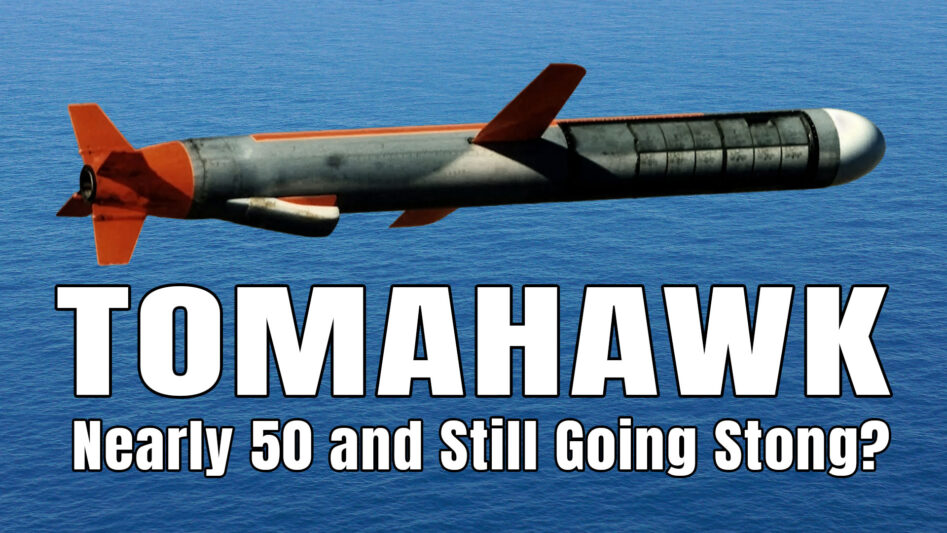
It’s not the fastest, it hasn’t got the biggest payload and its now 49 years since the prototypes first flew, but in a world of hypersonics and AI, the Tomahawk cruise missile is still a weapon that keeps leaders of countries that might be on the receiving end of these, awake at night.
So why are they so feared, considering all the technological advances in detection, electronic warfare and anti-missile systems, how does it fare nearly 50 years of almost continuous development and over 2350 have been used in active combat situations.
The tomahawk started out in 1971 as a US Navy project to see if it would be possible to launch a strategic cruise missile from a submarine, either from the existing, but large missile tubes or the smaller torpedo tubes.
Now cruise missiles had been used with submarines before, the problem was they had to be launched from the decks of the submarines which meant that the submarine had to surface and then set up the cruise missile for launch, all of which would take time and during this process leave it vulnerable to attack.
Launching the missile from underwater was seen as the best possible option, but it also needed a very long range which ruled out a rocket engine to fit in the small size and a high efficiency turbofan would be used instead.
But to launch a turbofan powered missile from under water would require a miniature solid rocket motor that would ignite once it have exited the torpedo tube. This would push it thru the water to the surface to a about 100 meters into air before the air inlet for the engine opened and the wings and tail fins popped out of the casing to carry on the main stage of the flight.
Two companies were given the contract to build and test prototypes for the proof of concept. These were General Dynamics and LTV. During the trials between 1974 and 1976, the LTV ZBGM-110A failed on two occasions but the General Dynamics ZBGM-109A worked flawlessly and General Dynamics won the contract.
Although built by General Dynamics much of the navigation technology was developed by the APL or Applied Physics Laboratory of Johns Hopkins University, who had worked on advanced navigation system since the 1950s
As befits the U.S tradition of giving Native American-derived names to weapons, it was assigned the name Tomahawk, a well known word for a compact, hard-hitting weapon, which fits the missile rather well, its official name is the BGM-109 Tomahawk Land Attack Missile or TLAM.
By 1980, a ship launched version was also being built and by 1984 a nuclear ground launched version called the BGM-109G Gryphon was co-developed. This carried a single W-84 10 to 50 kT nuclear warhead.
The US deployed 322 Gryphon missiles aboard 95 TEL vehicles. However, after the Intermediate-Range Nuclear Forces Treaty between the United States and the Soviet Union came in to force, that was missile launchers with ranges of 1,000–5,500 km (620–3,420 mi), the entire stock of Gryphons were destroyed by 1991 in accordance with the treaty.
The key for any cruise missile is navigation, it has to be able to be launched anywhere in the world and find its target autonomously.
Of course back before the mid-1980s, GPS did not exist. The way the missile would find its way was through a combination of an inertial navigation system – INS, a terrain-contour matching system – TERCOM and for the final hitting the target part a Digital Scene Matching Area Corellator – DSMAC.
The accuracy of the inertial navigation system alone was good enough to get it near the target and for mid course corrections, but the longer the journey, the greater the error that occurs. That’s just the way they worked as a mechanical device relying upon spinning gyroscopes, they were good but not good to find a pinpoint target up to 2500km, 1500 miles away.
With an error of 0.01° per hour, a flight of 1000 Km would out by up to about 150m, so a 2500Km flight or 1500 miles, the error could be upto least 375m, enough to miss the target completely, though that might not be too much of a problem if it had a nuclear war head.
But all of the Tomahawks that have been used, had conventional warheads of upto 450Kg and thus required a much greater accuracy.
So, they backed it up with a terrain-contour matching system – TERCOM. This would use digitized terrain maps which the onboard computer could follow and then compare to the data from its on-board radar altimeter and make corrections along the way to compensate for those introduced by the inertial navigation.
Because it is following the terrain it can stay very close the ground to evade radar and its slim fuselage has a very low radar cross section, which at very altitudes makes it very difficult to detect even today.
But why not use just TERCOM, well the problem is that flying across large bodies of water, like lakes or the sea, there would be no useful terrain data, so the INS would still be needed to point it in the right the direction and TERCOM would check the fine course details to make course adjustments.
However, what happens when you want to hit a specific building in a city or industrial, area, or a bunker in the country for example.
This is where the final digital scene-matching – DSMAC comes in. This uses photographs of the target and the area around it and a camera in the missile. This scans the ground as it travels, looking for a match so that the missile would know where it was during its terminal phase. It did have a weakness though, in areas of flat open terrain and of little visual detail like in desert areas, the accuracy could be affected.
For the anti-ship version, the Tomahawk used an active radar seeker, rather than TERCOM or DSMAC which derived from the Harpoon missile for sea-skimming, pop-up terminal attacks.
These first gen Tomahawks were known as known as the Block 1 and entered operations in the early 1980s. The accuracy or the circular error probable of the block 1s without the DSMAC was around the 80m, but the Block 2s with the DSMAC, this drops to about 10m, making it the most accurate long range cruise missile in the world at the time.
However, this meant that it relied upon up to date terrain maps, and images of the target, should any of that change, then the accuracy could be compromised. This information could take several days to prepare, so if a high value target were mobile, it might be too slow to respond.
The first time Tomahawks were used in combat was in 1991 Operation Desert Storm, these were the Block 2 version and didn’t yet have GPS but they proved to be a very effective weapon, taking out strategic targets and air defence systems.
Only Tomahawks and F-117s with laser-guided bombs were stealthy enough to attack the heavily defended targets in Baghdad, which was considered to have air defenses more formidable than those of any Eastern European target at the height of the Cold War. Tomahawks made up 2/3rds of all the weapons used during the initial strike with 106 being launched in the first wave and 290 in total for the duration of the conflict and out of that number 242 hit their targets.
This is one of the reasons why in Operation Desert Storm, they would follow routes chosen to avoid known air defences systems, radar, and in the pre-gps days, open areas of desert. In the initial attack, many flew in to Iraq from Iran and over the Zagros Mountains, which gave the systems a much better terrain relief to follow compared with a straight very flat over the desert southern route from the Gulf and was a more unexpected route to the Iraqis to expect an attack to come from.
This sent out a message to potential adversaries that this type of warfare by missile could be highly effect against even the best defended areas.
The next big change came with the Block 3 version of the 1994. This introduced Jam resistant GPS and new more powerful control system to replace the old tank based “green screen”.
The DSMAC was also upgraded to DSMAC 2, to take in a greater area around the target to counter the issues they had seen in the flat deserts of Iraq.
One the benefits of the GPS upgrade was that this allowed three types of attack to be mounted. GPS-only, for rapid mission planning of down to just 1 hour but with some reduced accuracy. DSMAC-only, which take longer to plan but terminal accuracy is somewhat better but upto 80 hours planning time was needed and the third were GPS-aided missions that combine DSMAC II and GPS navigation for greatest accuracy but longer planing times than just GPS.
The GPS not only helped back up the other systems, it added greater accuracy with some reports saying it was less than 5 meters but officially it was quoted at less than 10m. The turbo fan engine was updated to be 20% more efficient and 3% more powerful.
GPS also allowed it arrive at a particular time or to loiter over a target while waiting for other assets to arrive.
The Block 3s first time in combat was in the Bosnian War of 1993 when 13 were used to attack Bosnian Serb air-defence sites.
The Block IV “Tactical Tomahawk” missiles arrived in 2004 along a raft of new capabilities and was the last major update. The first of these was to be able to be reprogrammed while in-flight via two-way satellite communications to strike any of 15 pre-programmed alternate targets or redirect the missile to any GPS target coordinates.
It could also send images back to its command base to assess damage from previous attacks so to be able to direct attacks against a new target if the existing one had been destroyed.
It also had an updated anti jamming version of GPS. Anti jamming GPS systems use specially shaped antenna’s which form nulls in the signal reception but preserves the antenna’s view of the GPS satellites while greatly reducing the effects of jamming signals.
By 2020 and due to the importance that the Tomahawk had gained over the years, the US Navy started Block 5 which was a recertification and modernisation program to keep it in service for the next 15 years.
These included upgraded navigation and communications, a new seeker head for the antiship version to be able to hit moving ships and programmable Joint Multiple Effects Warhead System – JMEWS warhead that can be used against soft target or hardened bunkers without the need to change the warhead.
This is how the Tomahawk has managed to keep relevant for the last 49 years, a constant program of updates to the modular design without having to build a new chassis. There might well be new weapons like the hypersonic missiles and highly specialised missiles but the wide coverage that the tomahawk brings will keep in in use well in the 2040s.
What has really being making a difference in to how things will move forward, is Ukraines success in creating home grown drones and now cruise missiles like the flamingo, for a fraction of the cost of tradition western made ones and in very short turnaround times.
The big arms producers are already looking at how they can replicate the Ukrainian model to produce things like the Tomahawk at much lower costs and in much greater numbers.
Although there are plans to replace the Tomahawk with the Next Generation Land Attack Weapon, which is expected to be operational around 2028-2030. However, if this new ethos takes root quickly in the west there might well be other new low cost mass produced weapons coming down the line in the not too distant future.
So I hope you enjoyed the video and if you did then please thumbs up share and subscribe.
