
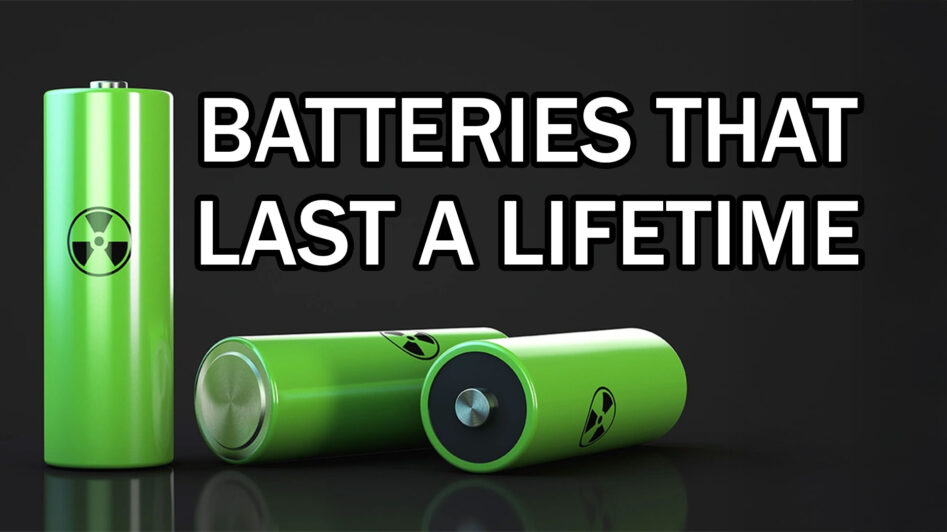
We tend to forget about the humble battery, the power source that is in every electronic device that is not wired to the mains. It’s the power and the Achilles heel of electric vehicles, it’s the thing that runs out after a day of using your Apple watch and yet it provides a backup to the grid and makes solar farms far more useful when the sun goes down.
Battery technology has come a long way in the last 40-odd years. When I was a kid we only had carbon batteries for our toys and lead acid batteries for cars and trucks, to start them not to make the move, except in milk floats.
It’s only since the 1990s that lithium-based batteries have been available commercially, although they were first demonstrated in 1976, and they have transformed portable electronics. Without them, things like our modern smartphones, tablets and whole range of modern portable computing devices would either not exist or be nowhere near as thin and lightweight as they are now, and the modern EV just wouldn’t exist.
But there is a problem with chemical batteries, if they are single use ones their lifetime is very limited unless they are lithium-based and used with very low-power devices.
If they are rechargeable ones then they need to be recharged on a regular basis and the faster you charge and discharge them the shorter their life becomes.
But what if we could produce batteries that had a different type of electrical generation, ones which were not limited to chemical processes, batteries that could last for 50 or even a 100 years or more, before they need to be replaced?
If this could be achieved it would revolutionise the Internet of Things, space travel, human medical procedures and robotics.
The type of battery we’re talking about are nuclear-powered batteries, also called atomic batteries, although they aren’t really batteries but generators because they don’t have any chemical reactions in them that create electrical power.
This was first discovered in 1913 by Henry Moseley when he first demonstrated that a current could be generated by charged particle radiation.
These generators rely upon the decay of radioactive elements to generate an electrical current either indirectly by heat working on thermoelectric generators or directly using the particles released and acting on semiconductors , similar to how light generates power with a solar cell.
We’ve already had nuclear generators in spacecraft in the form of RTG’s or radioisotope thermoelectric generators. These have powered all the space probes which have visited the outer planets because there is just too little sunlight for solar panels to work these distances.
Radioisotopes like uranium and plutonium are very power dense. A 20 gram pellet of uranium about half the height of an AA battery has the same energy as a tonne of coal, 450 litres of crude oil or 17,000 cubic feet of natural gas
Radioactive elements like uranium and plutonium release alpha, beta and gamma radiation, much of that as heat as they decay, this is surrounded by a thermoelectric generator, basically layers of dissimilar materials which when heated up generate a current.
The ones used in the Voyagers 1 and 2, had three RTG’s, each one containing about four and a half kilogrammes of plutonium 238 and 312 silicon-germanium thermoelectric couples generating approximately 157 watts of power which halves every 87.7 years, the half life for plutonium 238.
The total electrical power when launched was 470 watts, but today is approximately half that and with power conservation strategies like turning off unwanted equipment it may be able to supply enough power to return engineering data back to earth until 2036, a total of 59 years.
But this technology has also been used a lot closer to home, in fact in the 1970s French and U.S companies developed nuclear power cells using plutonium for pacemakers which works in a similar way creating heat which was then turned into an electrical current and embedded into people’s chests to give a regular trigger to people with irregular heartbeat problems.
Now you may well think how can you put a radioactive substance like plutonium actually inside someone and not cause them serious harm?
Well, this was done by surrounding a tiny amount of plutonium with layers of shielding material so there was very little radiation release. Both Alpha and beta radiation can be blocked by thin layers of aluminium or hydrogen-rich materials. But his made them larger and heavier than normal non-nuclear versions.
The unit’s electronics were embedded in epoxy and the hard titanium case is designed to withstand any credible event including gunshots and cremation.
The reason for doing this was at the time it was thought that they could last for decades and never need replacing, saving on operations.
Back in the 2000s there were still ppl alive who had these implanted in the 70s and 80s. When they die their pacemaker should be removed and sent to Los Alamos where the plutonium will be recovered.
They stopped being used because the cost and technological advantages of lithium cells and lower-power electronics meant that the plutonium-powered devices were just too expensive to use and to dispose of them.
It was also realised that having to replace the battery maybe every 10 to 15 years would also give a chance to upgrade the unit to something which would be more efficient, smaller and cheaper, rather than leave in a decades-old tech.
There are several other ways to harness the radiation emitted and one of these is called radio voltaic conversion, these can work on alpha, beta or gamma radiation.
Betavoltaics which work using beta particles were also used in pacemakers in the 1970s. The main advantage that they have over plutonium-based ones was they use a non-thermal process to generate electricity, these convert to the electron-hole pairs produced by an ionising trail of beta particles traversing a semiconductor.
These are particularly well suited to low-power applications where very long life for the energy source is required.
Although they were used in some pacemakers in the 1970s they were phased out as cheaper lithium batteries became more well developed.
The early semiconducting materials were inefficient at converting electrons from beta decay into current requiring more hazardous isotopes.
But in the last six or seven years, new types of semiconductors have been developed which are more sensitive and allow for less radioactive isotopes to be used.
In 2024, Chinese company Betavolt announced a miniature device which allegedly generates 100 micro watts of power at 3 volts with a lifetime of 50 years and used either carbon 14 or nickel 63.
These could be made into coin-sized cells and as it decays it turns into a stable version of the non-radioactive copper 63, so when it’s disposed of it’s no longer a hazard to the environment.
Because they are single cell generators they can be stacked either in series to increase the voltage or parallel to increase the current or a combination of both to create larger capacity generators.
But their main use would be to power devices which are installed in places which are very difficult to get at and would be cost prohibitive to replace and could run for decades.
This will become ever more prevalent with the Internet of Things like sensors Embedded into complex systems in remote areas with no external power which allow them to communicate over the Internet without the need to replace the batteries.
But what about powering things like cars or drones? Well, the problem here is that although radioisotopes like plutonium and uranium are incredibly energy dense, easily into the millions of times more energy dense than fossil fuels, when you’re talking about very small pieces of them the amount of energy they give off is really quite small. Then there is the conversion from the radiation to a direct electrical current that would be used to power a motor for example.
All current nuclear battery technology, be that either RTGs or Betavoltaic batteries have efficiencies between about 2 and 8%, which is a lot less efficient than an internal combustion engine at about 18 – 20%.
Conventional nuclear fission reactors have a thermal efficiency of between about 33 and 37% but newer very high-temperature designs can achieve as high as 45 to 50% making them far more efficient than the technology used in nuclear batteries.
Something else that you can’t do with an nuclear battery is increase or decrease the power based on the rate of radioactive decay, that is fixed and cannot be changed or even stopped.
Unlike an internal combustion engine where you can carry a relatively small amount of fuel around with you and then just top it up as you go along, for a car to use a nuclear battery you would need to have all the fuel available from the very beginning. It would be a bit like buying a diesel car and then towing a tanker behind it with 30,000 litres of fuel even if you only wanted to nip down to the supermarket.
If you want more power from an atomic battery, then you have to have more radioactive material, and the more you have the more becomes the problem of radiation shielding which then becomes large and heavy.
So when we look at it from this point of view atomic batteries are really only useful when you want low power in an inaccessible place for very long periods of time, like on a spacecraft or at the bottom of the ocean or tiny sensor and transmitter in a very remote and inaccessible places, but not for anything which requires high current draw and rapidly changing power outputs.
So, your electric car won’t be getting a nuclear battery upgrade anytime soon unless we find a vastly superior way of converting radiation into electricity.
So thanks for watching and don’t forget to thumbs up, share and subscribe and don’t forget to check out Heros of history, its free to download and lot of fun to play.
