
Sometimes, some things seem like really good idea in principle, up until someone points out that those pesky laws of physics mean that it is actually much, much harder to do than it looks.
One of those ideas is the Space elevator, something that’s been around as an idea since 1895 but it wasn’t until the 1960s that it was actually thought to be possible and since then there has been a lot of work being done by the likes of NASA, the Japanese space agency and private companies to try and make it a reality.
But as of yet, it’s a bit like creating a fully functional fusion reactor in that it’s just around the corner but we appear to be driving around a giant roundabout.
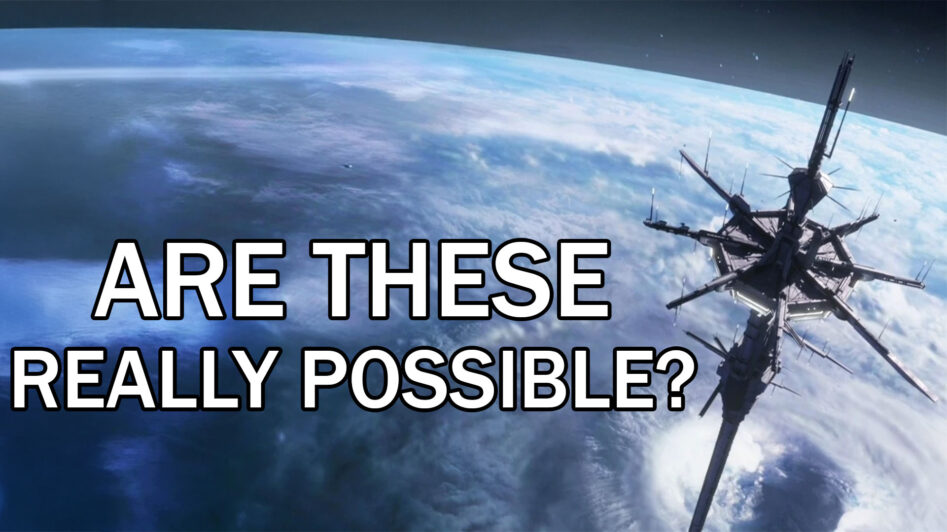
The basic idea is pretty simple. You place a satellite in a geosynchronous orbit around the earth at 35,768km, so that it stays in the same place above the surface.
You then lower a 35,768km long cable down to the earth and fix it in position, while at the same time, a counter weight would be attached to another cable, but this time the counterweight would be extended away from the satellite in the opposite direction into space. This would allow the centre of mass to stay at the position of the geostationary satellite.
You can then use climbers, similar to lift cars to climb up and down the cable to deliver goods and people into space far more cost-effectively on a cost per kg basis than launching a rocket. At a speed of 300km per hour it would still take about 5 days for the climber to reach the satellite and more to go higher to reach and escape velocity orbit on the outward extending tether.
But as they say, the devil is in the details, and in this case, the details mostly revolve around the laws of physics.
It was the Russian scientist Konstantin Tsiolkovsky in 1895 who, inspired by the Eiffel Tower, proposed building a tower from the earth up to the geostationary orbit at 35,768km. Any objects which climbed up tower would attain horizontal velocity, if a satellite were to be released at the top of the tower it would stay at that point in orbit and not fall back down to earth.
The problem here is that the weight of the tower would be so great that its base would have to be hundreds of kilometres across so that it wouldn’t buckle under its own weight. This was clearly an impractical idea.
But some 60-odd years later in 1960 it was independently developed by another Russian scientist Yuri Artsutanov, and in the mid 1970s by the American .
Both used the idea of using the geosynchronous satellite which we’ve just spoke about, and tethered to the earth via very long cable, though Pearson who didn’t know about Artsutanov’s work went much further as he was an aerospace engineer for both NASA and the Air Force Research Laboratory and did much more research into every aspect of it.
This idea remained obscure until 1979 when Arthur C. Clarke published his sci-fi novel “The Fountains of paradise” in which engineers built a space elevator on top of a mountain on a fictional island at the equator.
Now these ideas seem all well and good on the surface, but the geostationary satellite with a cable hanging down to the earth suffers the same problem as building the giant tower as proposed by Tsiolkovsky, in that the weight of the cable hanging from the top would be so great that it would snap long before it ever made it to the Earth’s surface.
This is of course assuming it was made out of something like steel which most elevator car cables are constructed from.
Artsutanov realised this issue and suggested that the cable would get progressively thicker as it got higher and higher up until it reached its maximum width when it was attached to the satellite. This was so the stress along the cable would remain consistent at any point along its length, this varying thickness is called the taper.
At the very top of the cable it would have to support the weight of all of the cable below it, where as at the very bottom of the cable where it’s attached to the earth it would be very thin because there is no weight pulling down on it at the earth end and of course you would need to allow for the weight of the climbers and load being transported plus a safety margin.
This is where the laws of physics really start to mess with your ideas. Steel is a very strong material but it’s also heavy with a specific strength of 0.63 MPa. The longest theoretical steel cable that could be hung vertically without snapping under its own weight would be about 10 to 12 kilometres, Depending upon the type of steel, the construction and its breaking strength.
But when you get into lengths of hundreds or thousands of kilometres it isn’t strong enough to hold its own weight without becoming exponentially thicker at one end.
If you look at the taper ratio for some materials, steel while being strong has a way greater density so its taper ratio will be 1.6 x 1033.
This means that to hold a cable up made of steel vertically which would be 35,768 kilometres long would mean the thickness of the cable at the top would be wider than the known universe.
Any material with a specific strength of greater than 48Mpa will have much lower taper ratios
If you look at single-wall carbon nanotubes, it has a tensile strength 26 times that of steel and a specific strength of 100, so its taper ratio is only 1.6.
Whatever material is used, it has to be not only incredibly strong but also incredibly light. So far carbon nanotubes are among the best thing we have. These are made from football-shaped molecules which are made-up of 60 carbon atoms and then stretched to create a tube-like structure.
In computer simulations, a thread just one millimetre in diameter had a theoretical breaking length of greater than 10,000 kilometres and could hold a mass of 20 tonnes.
However, the problem here is that the longest carbon nanotube we’ve been able to make so far is about half a metre long and nobody knows quite how to make the 100,000 kilometre long thread required to build a space elevator.
And this is where the focus has been on, to try and create materials that have a very high tensile strength to density ratio. The newest so far have been graphene ribbons made of perfect two-dimensional sheet of carbon which are expected to have breaking lengths 5000 to 6000 kilometres and 60 MPa.
However, if this were to be done on Mars it would be much easier.
The gravity on Mars is 38% that of Earth, yet it rotates at a similar speed to that of earth. This means that the tether required for a space elevator on Mars would be much shorter as the areostationary orbit is only 17,032 km, and thus requiring a lower specific strength. Existing materials such as Kevlar would be strong enough to produce such a tether.
The other problem with Mars would be that the Martian moon Phobos is in a low orbit which intersects the equator twice a day where the elevator would be placed. But there is a silver lining to this as Phobos is projected to contain high amounts of carbon, so if carbon nanotubes were to be the tether material, there could be a large amount near mars without relying upon shipping it from earth.
All of these ideas assume that we have a method of getting the material required into orbit on a much greater quantity than now, and it might take hundreds or thousands of launches in order to build the first space elevator.
It would also rely upon possibly the capture of an asteroid to make the counterweight but another way would be to capture some of the space junk in the nearby by graveyard orbit and from lower orbits.
But we still haven’t been able to come up with an idea of how to do this on mass, so it might be almost easier to try and capture an asteroid.
However, once the first space elevator was built, the following ones would be easier because they could use the first elevator to carry material up into orbit to build them.
Once a space elevator has been built and if the counterweight cable could be used as a launching platform if it reached a radius of 53,100 kilometres, then a spaceprobe launched from there would be at escape velocity from earth.
Other proposals by Jerome Pearson were to have up to 144,000 kilometre long cable if this were so then velocity at the end would be great enough to send probes to as far out as Jupiter.
In the last 20 years, there have been a lot of discussions about the creation of space elevators, but at the end of the day it will be our ability to create a tether light enough, strong enough and long enough that will determine if this idea ever gets off the ground, pun intended.
So I hope you enjoyed the video and a big thanks goes to all our patreons for there on going support.
