
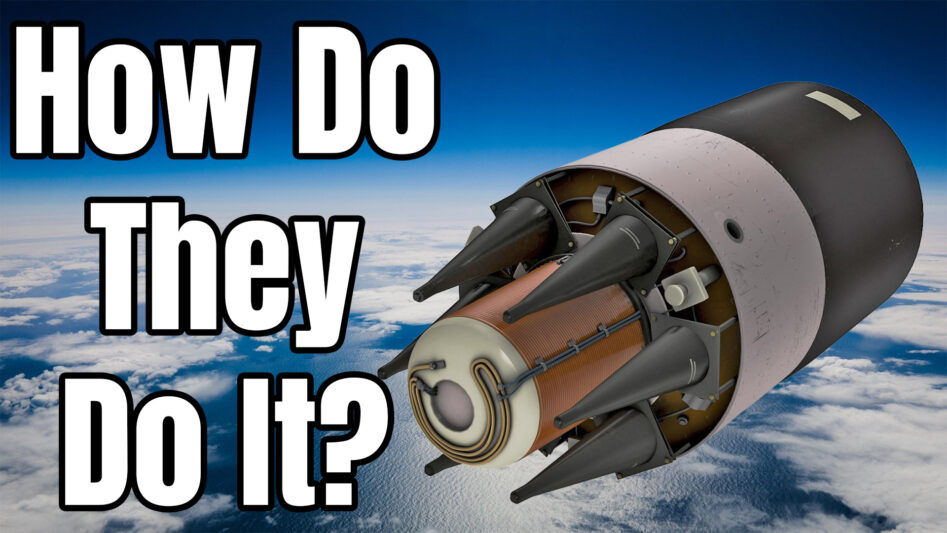
Have you ever wondered how a nuclear missile can find its way half way across the world and to be within less than 100 meters of it’s target and not use GPS?.
In fact, as the accuracy of intercontinental ballistic missiles or ICBM’s, increased, the size of the warheads decreased, which why the nuclear warheads of the early late 1950s to early 1960s were the largest ever created, because at the time the accuracy of ballistic missiles was about 1-3 km or 0.6 to 1.9 miles. Even megaton devices might not destroy hardened deep underground facilities, if they were detonated nearly 2 miles away.
So, the race was on to make the missiles as accurate as possible and the spin off from this would enable both the moon landings and the exploration of the solar system.
This need to deliver a warhead to a remote target can be traced back to the V1 and in particular the V2 weapons that Germany developed during the Second World War.
There had been many attempts to create a way of delivering large explosives to a target with remote controlled aircraft, these were in fact the ancestors of the drones we see today. But these we’re just remote controlled aircraft which used early television cameras which beamed the signal back to another aircraft which would be flying close by to guide it to its target with a full load of explosives.
The V1 flying bomb was different because unlike the remote controlled versions of aircraft, the V1 was autonomous, once they had launched they would carry on until they were either shot down or they hit on or near the target.
In fact it didn’t really matter if they didn’t hit the target, they were terror weapons, designed to instil fear into the population where they were targeted at. The fact that they could come down almost anywhere made it even more scary, and that’s exactly what the Germans we’re trying to achieve.
But the problem with these was, that they were still just aircraft, and they were still relatively slow moving and could be shot down by fighter aircraft or anti-aircraft fire, and about 45% of them were brought down this way before they could reach their target.
The next development, the V2 would bypass this completely, they would launch and fly high up almost to the edge of space before following a ballistic path down to the chosen target area.
This meant that they were completely out of a range of conventional weapons, and on their return journey their terminal velocity just before impact would reach approximately 1,790 mph (2880 km/h) about 2.3 times the speed of sound, the only time you knew a V2 was approaching was when it hit the ground.
The V2 was a liquid fuelled ballistic missile capable of carrying a tonne of high explosive upto 320km or 200 miles and it was fully autonomous, once launched, it like the V1 would carry on until it hit on or near the target without any external input.
The guidance system of the V2 was a form of early inertial navigation system or INS. These had been used in aircraft autopilots the keep them in level flight without the input of a pilot, but this was the first time they had been used to guide a ballistic missile to its target.
The inertial navigation system used gyroscopes which were connected to a variable resistor, this controlled a voltage which drove motors to eight move fins. Four of these air vanes would be for aerodynamic control whilst another 4 graphite vanes would be positioned within the rocket exhaust stream which would provide powerful directional control even at low speeds and high altitudes.
One pair of these control surfaces were dedicated to pitch control, this would tilt for rocket up to 45° from the vertical which was essential for the optimal angle to achieve maximum range.
The final part was the engine cut off, this used an accelerometer to measure acceleration and velocity. When the rocket reached a predetermined velocity and distance depending upon the target, the engine was cut off at which point the rocket would then fall back on a ballistic path as an unguided projectile on to the target.
All though very advanced at the time, by today’s standards it is very primitive and didn’t allow for course corrections or evasive manoeuvres.
This technology was far more advanced but anything the allies had and after the war the Americans, British and Soviet all made Concerted efforts to get their hands not only on The Rockets themselves but the scientists that made them.
Many of the top German rocket scientists were brought to the US in operation paperclip including the lead designer of the V2, Werner von Braun.
Although von Braun had dreamed of going to space before World War 2, Space was the last thing the US military was thinking about just after the war ended. At that time they wanted rockets, rockets that could possibly carry their newly developed atomic bomb.
But placing a nuclear weapon on a rocket and firing it into the sky was one thing but getting it to guide itself thousands of miles to a target deep within the Soviet Union was another.
The biggest problem that the engineers had with the early rockets based on the V2 platform what’s that any sensors that would be used as part of the inertial navigation system would have to put up with the rocket shaking, vibrating, pitching and yawing and these could have a dramatic effect on the accuracy of the system.
What was needed was a stabilised platform that would remain in the same position irrespective of what the rocket was doing.
This is known as a gimbal stable platform and has three gyroscope rings, each one rotating about a different axis. The outer gimbal rotates around yaw, the nose rotates left/right. The middle gimbal rotates around pitch, the nose rotates up/down, and the inner gimbal rotates around roll, wings tilt left/right.
Each ring has a gyroscope which maintains its orientation due to the conservation of angular momentum, if the missile rotates in one direction the gyroscope the detects this and sends a signal to motors on the gimbal which rotate it in the opposite direction just enough to cancel out the missiles movement.
Inside the inner gimbal is the stable platform that is now isolated from the movement of what the missile itself is doing.
Because the platform stays level the accelerometers measure true acceleration, not confused by vehicle tilt, this data can be integrated to calculate velocity and then position, without a stable platform, tilt would make accelerometers useless.
So how does it work in practice.
Before Launch The platform is aimed at a reference direction, to do this one axis points north, one axis points east, and one points straight up. This becomes the orientation reference for the whole flight, so now any movement can be compared to this initial setting.
At launch and during the flight the platform stays in the same orientation as it was before the launch. This allows the platform to measure true forward acceleration, true sideways drift and true vertical changes.
With these it can then tell the missile: how high it is, how far it has travelled, whether it is drifting off course and when it should shut down engines for the final decent and how to steer.
This technology was developed in the early 1950s and would form the basis of all early ICBM guidance systems and later the Apollo Inertial Measurement Unit. However, the technology of the time still relied on thermionic valves and the gyroscopic elements were affected by the quality of build that could be achieved at the time.
The result of this was the gyroscopes would drift over time and the longer they were running the more the drift would become and the greater the inaccuracies would be.
By the late 1950s and with the introduction of the Atlas, Titan, Thor and Jupiter rockets, analogue computers we’re being used to integrate accelerometer data and gyroscopes and were capable of between 1 to 2 kilometres of accuracy.
Advances continue to be made throughout 50s and into the 60s as valves gave way to all transistor digital computers and fluid supported rotors on gyros. These were used on the minuteman missiles and became a direct ancestor to the Apollo guidance system. But there was still an element of drift no matter how good these mechanics and electronics became.
By the mid-1960s star sighting was added and brought back a technique which the ancient sailors would have recognised, basically by using periscopes or small telescopes whilst the missile was in this space based phase, it would compare the star patterns with an onboard catalogue and then update the inertial measurement to remove drift.
Apollo did a similar thing with this optical sextant and IMU although this was normally done by a human but the technology was originally used in the Polaris A-3 and the Poseidon C-3 ICBM’s.
Developments in technology during the 1970s and 1980s enabled the accuracy to move from approximately 1 kilometre to about 100 metres and enabled the use of MIRVs or Multiple Independent Reentry Vehicle, in essence, one missile could carry multiple warheads, each capable of hitting separate targets.
One of the big changes that came was the move from physically rotating gimbals on a stable platform, to strapping down the gyros and accelerometers directly to the missile body and then using digital computation to mathematically rotate the measurements into a virtual stable frame.
This removed the issue of gimbal lock which could occur when two of the three axis would aline and lock, removing the ability to measure one of the axis. It was also far lighter cheaper and more reliable and had a faster response and more tolerant to vibrations and this became standard in the late 1970s.
By the 1980s spinning mechanical rotors were phased out and new gyros using light were introduced. These were known as Ring Lasers Gyros, RLG’s or Fiber-Optic Gyros, FOGs.
So how does laser gyro work. Well, a laser beam is created and then split into two beams. Both following a path inside a laser medium in the form a cube or triangle with the internal sides acting as mirrors.
One beam goes in the clockwise direction, and the other goes in the anticlockwise direction. Depending upon the direction of rotation, the beam that goes in the direction of the rotation, has a very slightly longer path, as the beam of light has to catch up with a rotating cube or triangle and the beam going in the opposite direction has a shorter path.
However, as they are both generated from the same laser beam they are exactly the same frequency and this slightly longer path shows itself is a slight decrease in frequency, and the shorter path a higher frequency, similar to the doppler effect. The faster the rotation the greater the frequency difference and by comparing which is higher or lower frequency you can determine the direction and rate of turn very accurately.
In fibre optic systems a long coil of fibre optic cable often hundreds of metres long is wrapped into a small coil and a similar process is done sending 2 beams in opposite directions through the fibre optic coil. Here the difference in phase between the two signals, this is detected and the direction and rate of turn can be computed.
These light based gyros had no moving parts and therefore no mechanical friction, they were extremely low drift, very reliable and immune to vibration and temperature variations, ideal for the space based part of the trajectory.
At the same time, solid-state accelerometers became available which were far more accurate and when partnered with ring laser gyros, the inertial error was cut dramatically compared to the older mechanical systems.
By the 1980s fully digital fault tolerant computers and microprocessors along with modern software for trajectory shaping, error modelling and thrust control enabled the real time optimization of trajectories with much more complex mid course manoeuvres and allowed for rapid pre-launch targeting.
Electronics were also radiation hardened and made resistant to mechanical shock as well as nuclear generated electromagnetic pulses. This allowed long storage lifetimes in silos to be achieved with reduced maintenance, although this contributed more to reliability and accuracy.
By the 1990s, CCD star sensors and digital pattern recognition allowed the missiles to do autonomous celestial navigation, but the biggest advanced was GPS or Global Positioning System. Now although this was a huge advance it was not actually used during mid flight because GPS signals can be jammed or even spoofed to make them appear to be somewhere where they’re not. Instead, GPS is used before launch to precisely align the missiles inertial platform.
The more accurate the launch conditions, the better the targeting at the other end could become and this could shave off sometimes hundreds of metres for silo based or mobile based launchers.
MIRVs , The multiple independent reentry vehicles, also gained their own inertial units and micro thrusters with closed loop control as well as star sensors, making them is accurate as a single missile system and allowed the warheads to be placed within 50 to 100 metres of the target in high end systems.
From the 2010s onwards AI and machine learning algorithms have been used to detect anomalies, predict drift and optimise trajectories. What they don’t do is autonomous targeting, the targets still have to be chosen by a human, it’s just the manoeuvring over rocket which is smarter.
And this brings us on to the current day and beyond with experimental systems using quantum accelerometers, atom interferometers and quantum gyros for extremely low drift. When these come into service they promise to have accuracy equal to or greater than hypersonic glide vehicles and because of the extremely low drift of the quantum devices, multi hour drift times are orders of magnitude less so there is no need for star fixes or GPS making them jam proof and ultra high precision.
Modern ICBM’s are now so accurate that inertial navigation only guidance can achieve target accuracy of well under 100 metres without any external signals. This brings us almost full circle back to the V2, the first ballistic missile which relied upon inertial guidance only to find its target although with today’s technology it can be almost as accurate as if it were a guided missile, and even the hardest targets can be pinpointed from the other side of the world and there is almost nothing that can stop a modern ICBM from finding its target.
So I hope you enjoyed the video and if you did then please thumbs up share and subscribe and a big thank you goes to all of our patrons for their ongoing support.
