
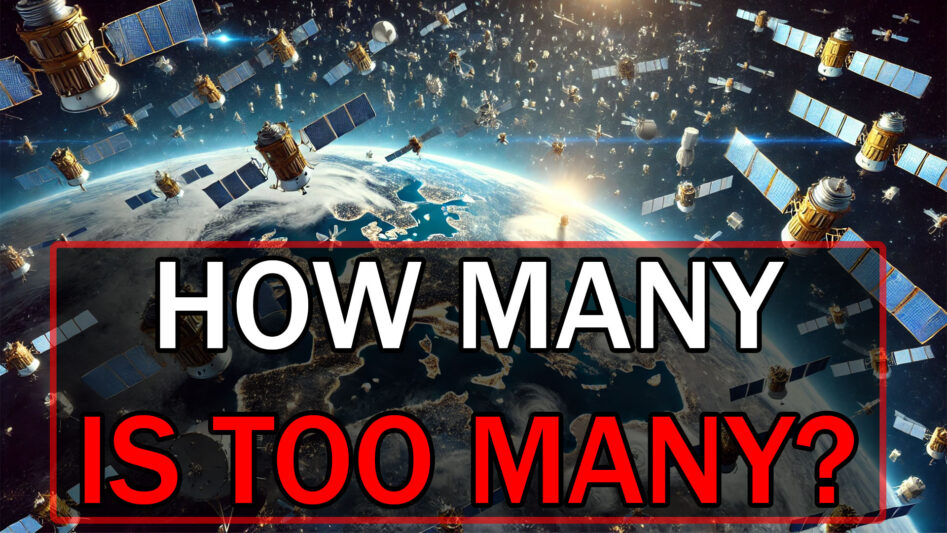
On the 3rd October 1957 the earth had one satellite, the moon. On the 4th October 1957 it had two with the addition of the Soviet Sputnik-1, the world’s first artificial satellite and although it only stayed in orbit for 22 days, it opened the floodgates and today we have about 11,833 active satellites in orbit, but that is expected to rise dramatically over the next decade or so with the rise of the mega satellite constellations like SpaceX’s Starlink.
But how many satellites can we put into orbit before things start to go wrong and if it does can we do anything about it?
Now that 11,833 also doesn’t account for all the non-active satellites and launch vehicles and debris from launches and even collisions dating back to 1958, with Vanguard 1.
Vanguard 1 was the first US satellite to orbit the Earth and 4th to be launched. It was also the first to have solar power and yet unlike Sputnik which burned up on 4th Jan 1958 , Vanguard 1 is still up there nearly 67 years after its 90 day planned mission was over, it actually kept transmitting for over six years in total.
The grapefruit sized craft was sent up to determine the total electron content between the satellite and ground stations. It is in a medium earth elliptical orbit between 654 kilometres at its closest point and just short of 4000 kilometres at its farthest.
Its original orbit was estimated to last about 2000 years but after the discovery of solar radiation pressure and atmospheric drag, this has been reduced down to about 240 years.
Both vanguard 1 and its launch vehicle as well as vanguard 2 and vanguard 3 and their launch vehicles are all still in the orbit around the earth and will be for about the same time as vanguard 1.
One of the main things that the Vanguard missions helped to discover was that the effect of atmosphere drag up to 800km was the largest perturbing force and above 800 kilometres, solar radiation pressure was the largest perturbing force. Both of these are also strongly affected by the solar cycle.
The lower the orbit of a satellite becomes the greater the drag from the Earth’s very thin upper atmosphere. The drag causes the speed of the satellite to decrease which causes the orbit to decrease even more until the atmospheric friction becomes so great that it burns up.
This may sound like a bad thing but actually, it turns out to be a very good thing because there is now estimated to be approximately 128 million pieces of debris in orbit with some 900,000 being over 1 centimetre in size.
That might sound very small but at relative speeds of up to 58,000 kilometres per hour even something the size of a grain of rice can punch through the side of a satellite quite easily. One of the glass windows of the cupola of the ISS is believed to have been cracked by such a sized piece of debris, at this speed even flecks of paint can become dangerous.
Most of these small pieces come from collisions with existing launch hardware, rocket bodies, defunct satellites and even the deliberate destruction of satellites in anti-satellite weapons tests.
Atmospheric drag is nature’s way of cleaning up the space just above the earth and the lower the orbit is, the more quickly the debris is cleared away as it burns up on re-entry into the atmosphere.
But things are going to become a lot busier because of the new mega-constellations of small sats currently being deployed.
Spacex’s starlink will have 12,000 satellites by the mid 2020s , Shanghai Spacecom’s G60/Qianfan will have 14,000 satellites by 2030, Amazon’s Project Kuiper will have 3,236 satellites and One Web 648 satellites, and this is not the end of the list or the expansion of existing constellations.
Starlink alone is seeking permission for just under 30,000 more satellites, and then there are more constellations in the planning, as well as military versions like Starshield, the military version of Starlink operated by The US Department of Defence.
There will no doubt be multiple military variations of this kind of thing which will be operated by other space-faring nation-states and all on their own terms.
Satellite constellations are networks of satellites designed to work together, providing global coverage for various purposes like communication, navigation or Earth observation.
This allows coverage at or near global levels. Normally this would be done with satellites in a geosynchronous orbit 35,786km out, here they are in sync with the rotation of the earth and as such they always sit over the same area of the globe.
But this distance, and the fact they are just single satellites means that their bandwidth is much less and the time delay to get the signal there and back adds a significant delay.
With a constellation, there are many more satellites moving over the receiver all the time and their distance of normally about 500km also means that the time delay is a fraction of that compared to geosynchronous satellites. This and the combined bandwidth which can be into the hundreds of megabits per second makes them far more practical and cost-effective from an operator’s and end user’s point of view.
These new low earth orbit constellations are providing services like broadband Internet connection into the hundreds of megabytes per second or mobile phone coverage for areas which are too remote to have normal land based connections. They also allow for much greater maritime and aviation connectivity, in fact the videos which are beamed back from SpaceX’s test launches of the Starship are sent via Starlink.
The issue here is that all these new constellations will dramatically increase the number of objects orbiting the earth which could lead to more collisions and more debris, and if a runaway collision cascade were to occur we could be facing the Kessler syndrome.
This is where there the debris from a single collision could in theory collide into other satellites, which in turn collide with more and so on and so forth, creating a self-sustaining chain-reaction of collisions and fragmentation until there is so much debris that even space launches and things like space stations are at risk of damage or destruction. This could make certain orbital regions unusable possibly for hundreds of years until they are gradually cleared out by the atmospheric drag.
From 2002, the FCC required all operators of Satellites serving the US territories that could not be safely deorbited, they had enough fuel onboard at the end of their life to be moved to a graveyard orbit, that’s one which is high enough, usually beyond geosynchronous orbits, that is out of the way and will take millions of years before they will makes it way back to earth.
With the advent of mega constellations, each of these small satellites don’t carry enough fuel to be moved to a graveyard orbit, they only have enough for avoidance manoeuvres. Instead, they are required to have orbits which will passively decay into the Earth’s atmosphere when the satellites are shut down or run out of manoeuvring fuel so that they can burn up within one year of the end of life.
To enable this satellites are placed into different orbital shells or orbital altitudes.
These include Very Low Earth Orbit from 100 to 450 km, Low Earth Orbit up 800km, Medium Earth Orbit from 2000km to 35,786km, Geostationary Orbit, and High Earth Orbit, the mega-constellations will be in the lowest two, Very Low Earth Orbit and Low Earth Orbit up 800km.
But within these orbits there can be multiple layers as well. For example, in December 2022 SpaceX gained approval to launch an additional 7500 satellites for its Gen 2 constellation into 3 low earth orbit orbital shells at 525, 530 and 535 kilometres, so here you can see the separation is just five kilometres in altitude between the orbital shells.
Newer satellites also include collision avoidance where they can either be told or automatically perform manoeuvres to avoid known debris or potential collisions with other satellites.
Starlink satellites are designed to be manoeuvrable and can execute manoeuvres to avoid collisions if the onboard software calculates the probability of a collision to be higher than 1 in 100,000 but this is a lot less than the 1 in million that NASA requires.
In the first half of 2024, Starlink’s fleet of satellites performed almost 50,000 collision-avoidance manoeuvres, and bear in mind that these satellites are travelling at 7.8km/s 4.8 miles/s.
However, according to the FCC each Starlink has only enough fuel to make about 350 corrections which is expected to be around 5 years but the busier the orbits get that might come a lot quicker.
Another issue is that as time goes by and more of these mega constellations come online, the more we will be dependent upon the services they provide. Should at some point, were there to be a cascade failure, it could severely affect services that we have become dependent upon.
The amount of money which is made for constellation owners is already into the billions of dollars per year with and starlinks projected revenue to reach $15.8 billion by 2030 with over 20 million subscribers.
This would Eventually outstrip the revenue from SpaceX’s launch business, meaning that SpaceX will be more reliant on Starlink for its revenue than its launch rockets.
So what is the upper limit of how many satellites we can fit into the earth’s orbit without the whole thing becoming a giant multi lane highway pile up.
Well as we’ve seen it depends upon where the satellites are placed, if they’re in low earth orbit even if their thrusters fail at the end of their missions a satellite orbiting at 400km will be brought down by the drag of the atmosphere within a year or so. But if that same satellite is at 1000 kilometres it could remain there for hundreds of years.
Experts in satellite safety say that in 10 years time from now there could be between 20,000 and 100,000 satellites in orbit around the earth, and if that number is nearer the 100,000 figure , many are sceptical that such a number of satellites can be operated safely.
As with climate change, the only way will know when we’ve reached the limit is when things start to go wrong, and like climate change by then it may be too late to do anything about it.
At the moment, unlike satellites in geostationary orbit, which is a very coveted place to be and only allocated to those on a first come first serve basis by the International Telecommunications Union, satellites in low earth orbit have only their own national bodies to regulate them and are under no obligation to coordinate with others.
When all the new mega constellations are in place Some have said it will be like having multiple interstate highways, all crossing each other at rush hour in a snowstorm with no stop lights and everyone driving far too fast.
There are initiatives to locate and de-orbit the most dangerous pieces of space junk, but like many things in commercial business, if it doesn’t affect the bottom line in a positive way and there is a race to dominate the market, there will be far more incentive to putting up new satellites than getting the old ones down and out of the way.
And even the best-run space agencies can make mistakes. Envisat, the largest civilian-operated satellite at the time was launched by ESA in 2002 with a planned mission life of 5 years, but it was kept going for 10 years before it became unresponsive to commands in 2012.
This 8-ton satellite which measures 26m x 10m x 5 m is now classed as space debris and will take 150 years before its current 774km orbit decays and it will burn up. However, it is an orbit that takes it within 200m of two other known debris objects every year.
If just a 10kg piece were to collide with it, it would create a very large debris cloud that could initiate a Kessler syndrome scenario and with possibly 100,000 small sats in orbits not that far away, if that happens could be a very bad day for the whole space industry.
So I hope you enjoyed the video and if you did please thumbs up, share and subscribe and a big thanks go to all our patreons for their ongoing support.
