
Sometime in 1988, at a test range called Kapustin Yar deep inside the Soviet Union, a team of engineers took the most powerful weapon their country had ever built, packed it with the better part of a ton of high explosive, and blew it to pieces. And then they did it again, and again, until every last one was gone.
These weren’t broken missiles, or obsolete ones. The RSD-10, known in the West as the SS-20 Saber, was little more than a decade old and it was, by almost any measure, the finest weapon in the Soviet arsenal.
So, why on earth would the Soviet Union agree to destroy it? Not a handful as a gesture, but the entire force, all 654 of them, destroyed one by one under the watchful eyes of American inspectors. Nations do not usually give up their best card. They certainly do not blow it up.
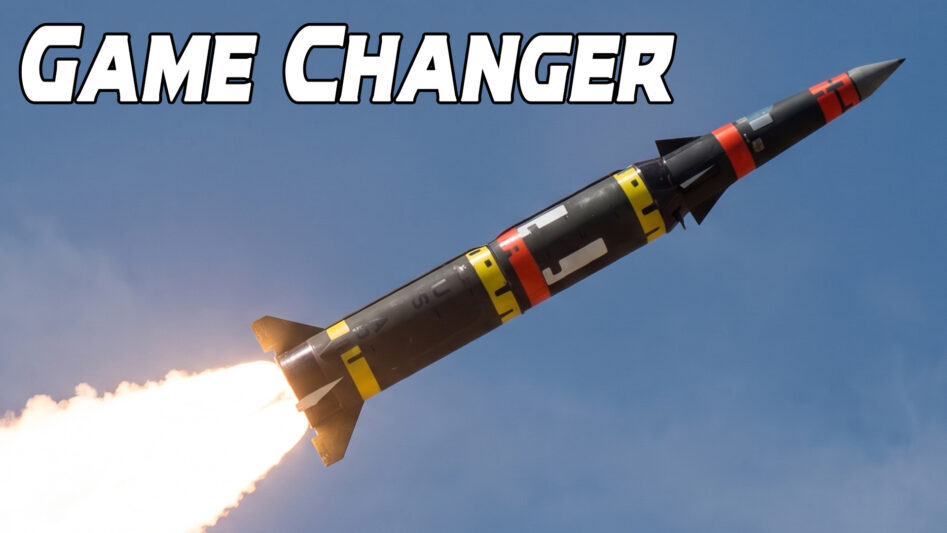
The answer wasn’t in Moscow at all. It was sitting in a field in West Germany, a single American missile, smaller than the one the Soviets were busy destroying, that they had decided they simply could not live with. This is the story of the Pershing II, a weapon came to terrify a superpower into scrapping its finest, and how the technology hidden inside it never really died at all.
It begins on the 31st October 1956, when the U.S Army requested a feasibility study for a new ballistic missile. Now, to understand that request you have to understand how frustrated the Army was. Just months earlier, Secretary of Defence Charles Wilson had stripped it of any missile with a range over 200 miles (320 km) and handed the long-range business to the Air Force. Yet here was the Army asking to study a ballistic missile of 500 to 750 nautical miles, roughly 900 to 1,400 km, at exactly the moment it had been told it couldn’t build one. The request went to the Army Ballistic Missile Agency at Redstone Arsenal, where Wernher von Braun’s team got to work, and by 1957 they had shown it was feasible. Conveniently, that same year, the range restriction was quietly cancelled.
In January 1958 the weapon was named Pershing, after General John J. “Black Jack” Pershing of First World War fame, and that March the whole development contract went to the Martin Company of Orlando, later Martin Marietta. That was itself a first, up to then the Army had always built its own missiles in-house.
So what were they building? They were making a replacement for the ageing Redstone, and the first, and as it turned out only, solid-fuelled medium-range ballistic missile the U.S Army ever deployed. The Redstone ran on liquid propellant, which had to be pumped in on the pad shortly before firing, a slow, dangerous, visible business that used highly volatile fuels. A solid propellant could sit inside the missile for years, ready to go at any time. Safer, easier to handle, and above all it meant the missile could be kept on permanent alert and fired at very short notice.
The first Pershing I flew on the 25th February 1960, and by 1962 the first battalion was active. It was a two-stage rocket about 34.6 feet (10.5 m) long, guided by an all-inertial system and fired from a tracked launcher, and that launcher introduced the idea the family became famous for, “shoot and scoot.” Rather than sit in a fixed silo waiting to be found, it drove out, put its missile up, fired, and was gone before anyone could hit back. Range was around 460 miles (740 km), double the Redstone’s, and it carried a W50 warhead with yields up to 400 kilotons.
But there was a catch, and that was the Pershing I’s accuracy, its circular error probable or CEP, was around 400 metres (1,310 feet). CEP is just the radius of the circle around the target inside which half your missiles land, so half of them would miss by more than 400 metres. The culprit was the inertial guidance, which works by measuring every acceleration and adding it up to track position, but tiny errors accumulate over distance, so the further you fly the more it drifts. Inertial guidance systems today are far more accurate, but back in the early 60s that wasn’t an option. And with inertial guidance only, there’s no looking down to check. To be sure of killing a hardened target with a missile that inaccurate, you needed a very large warhead and brute force.
Through the late 1960s the Pershing 1a improved the system, a faster wheeled launcher suited to German roads, solid-state electronics replaced valves, and the ability to fire several missiles in quick succession. By 1970 it had replaced the original entirely and was fielded by both the U.S Army and the West German Luftwaffe. For most of the 1970s this was NATO’s front-line nuclear missile in Europe, and it seemed perfectly adequate. And then the Soviets threw a rather large spanner in the works.
That spanner was the RSD-10, the SS-20 Saber, the very missile we watched being torn apart at Kapustin Yar in the opening. In the mid-1970s the Soviet Union began rolling it out, and it was a serious problem. It was mobile like the Pershing, but far more capable. It had three independently targetable warheads on one missile, with the range to hit targets right across Western Europe from deep inside Soviet territory. Suddenly Moscow could threaten every European capital with a modern, accurate weapon, while NATO’s Pershing 1a couldn’t even reach Soviet soil. The balance had strategically shifted in favour of the Soviets.
On the 12th December 1979 NATO made one of the more elegant, and controversial, decisions of the Cold War, the Double-Track Decision. It ran two tracks at once. Track one offered the Soviets immediate talks to remove the SS-20s. Track two committed NATO, if those talks failed by late 1983, to deploy 108 Pershing II launchers and 464 ground-launched cruise missiles into Western Europe. It was a four-year ultimatum, negotiate these things away, or we bring in something you’ll like even less.
So, what was so special about the Pershing II? On the surface it looked much like its predecessor, a two-stage solid-fuelled missile of about the same length fired from a wheeled launcher. New Hercules motors, their casings spun from lightweight Kevlar, pushed the range out to around 1,100 miles (1,770 km), enough for the first time to reach into the western Soviet Union. But the range wasn’t the clever part, that was hidden in the nose cone.
Remember that inertial guidance drifts, so accuracy gets worse with distance, and that a 400 metre CEP demanded an enormous warhead. The Pershing II solved that with a technology called RADAG, radar area guidance, on a manoeuvrable re-entry vehicle. It flew most of its path on inertial guidance as before, but as the warhead re-entered the atmosphere a small radar in the nose switched on, scanned the ground, and compared what it saw to a stored radar “map” of the target. Any difference told it how far off course it was, and it steered itself in using aerodynamic fins. Because that correction came right at the end, over the target, it cancelled out all the drift built up on the way down. The result was a CEP of around 30 metres (100 feet), and crucially, one that no longer got worse with range. It didn’t matter if the target was 100 miles (160 km) away or 2,000 miles (3,200 km), it would still have a CEP of around 30 metres.
Now think what 30 metres buys you. Land that close, and you can destroy a hardened, buried command bunker with a much smaller weapon. That’s why the Pershing II could carry the compact W85 warhead, with a dial-a-yield of just 5 to 80 kilotons, a fraction of the old 400 kiloton one, and still be more lethal against protected targets than its predecessor ever was.
And this is where you understand why the Soviet leader Gorbachev blinked. Put it together, a missile in West Germany, able to reach the western Soviet Union, able to land within 30 metres, able therefore to destroy the hardened command centres from which the Soviet leadership would run a nuclear war. Then add the last, most frightening ingredient, time. From Germany, a Pershing II could reach those targets in roughly eight to ten minutes, against the twenty-five to thirty an intercontinental missile takes from the United States. To Soviet planners that looked less like a battlefield weapon and more like a first strike decapitation weapon, one that could kill their leadership so fast and so precisely they might never order a response. Whether that was ever the intention hardly mattered. What mattered was that Moscow believed it.
The first test flight came on the 22nd July 1982, and when the talks stalled, deployment went ahead. The first missiles reached the 56th Field Artillery Brigade in West Germany in December 1983, and eventually all 108 launchers were in place. The Soviets walked out of the arms talks almost at once, and across Europe hundreds of thousands marched against the deployment, with protesters famously surrounding bases like Greenham Common in England for years. For a while the gamble looked like it might tear NATO apart from the inside.
But it worked, and that was the whole point of track two, to create something the Soviets wanted gone badly enough to trade their SS-20s for it. After the deadlock, and after Gorbachev arrived with a genuine appetite for cutting the nuclear burden, both sides came back to the table, and this time they didn’t just cap the weapons, they abolished them. The INF Treaty of the 8th December 1987 eliminated every American and Soviet ground-launched missile with a range between 500 and 5,500 km. Out went the SS-20s, SS-4s and SS-5s on one side, and the Pershing IIs, the older Pershing 1as and the cruise missiles on the other, roughly 2,700 Soviet missiles and around 800 American ones. The Pershing’s were mostly static-fired, bolted down and burned out where they lay, and their casings crushed. A weapon that took over a decade to build was gone within a few years, without ever being fired in anger.
However, that’s not the end of the story, destroying the missiles did not destroy the technology, it just scattered it. The treaty covered the missiles and launchers, not the warheads, so the W85s were pulled out and rebuilt into B61 gravity bombs still carried by American aircraft today. It didn’t cover the guidance sections either, so those radar-guided noses were bolted onto missile-defence target rockets, like the Hera, and fired so that new interceptors such as THAAD could practise shooting down something exactly like them. The very hardware built to beat Soviet defences ended up as a training rocket to teach the American ones.
The bigger legacy was the idea. Nobody shipped a Pershing part abroad, but the concept it proved, a manoeuvring warhead with its own terminal seeker, is exactly what reappeared in the anti-ship ballistic missile, the “carrier killer.” China’s DF-21D and DF-26 use the same trick, only now the target is a moving aircraft carrier rather than a bunker on a map. And the deployment idea outlived everything, the Pershing II’s self-locating launcher meant it could pull up almost anywhere and fire in minutes, and that is now how all mobile ballistic missiles work today.
More recently, when the U.S walked away from the INF Treaty in 2019 and the banned class crept back, the systems the Army rolled out to replace it, the road-mobile Typhon and the trailer-launched Dark Eagle hypersonic, are direct descendants of the Pershing 2 missile the treaty destroyed.
So, do you think the Pershing II really forced the Soviets’ hand, or were bigger forces already pulling both sides towards that treaty, and now that its whole banned class is quietly returning, are we simply watching the same story play out again? Let me know down in the comments. And if you enjoyed the video, please do thumbs up, share, and subscribe, and a bit thanks to our patreons for there on-going support.
The Pershing II nuclear missile of the early 1980s not only scared the soviets so much that they traded away their SS-20s to get rid of it, it also changed the way tactile battlefield operated for ever. From the limited U.S Army Pershing 1 missile of the 1960s, to the game changing Pershing II we look at how one weapon caused such a change.
