
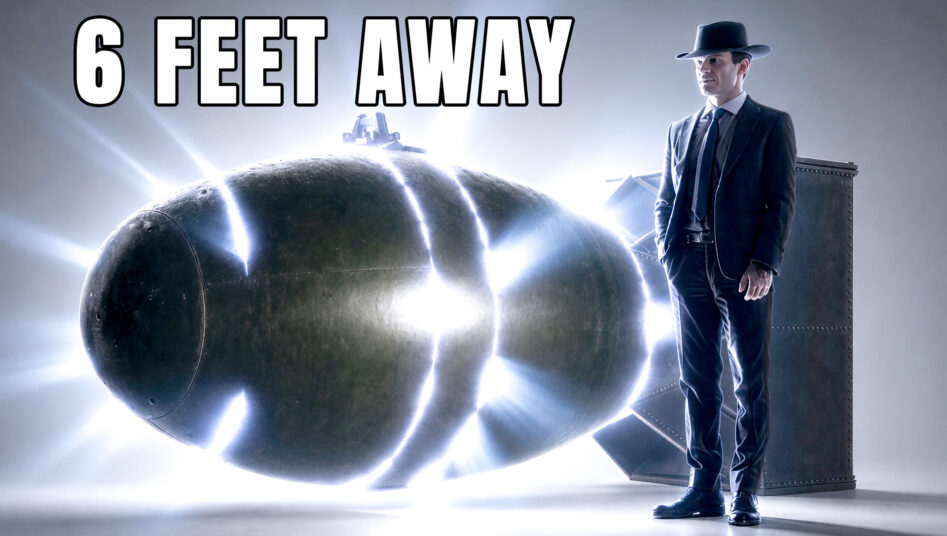
“Hotter than the Sun” is one of those phrases we reach for when we have run out of ways to describe something extreme. It sits alongside “faster than a speeding bullet”. A figure of speech, not a measurement.
But the centre of the Sun sits at around 15 million degrees Celsius, or 27 million Fahrenheit. Nothing we could build could survive there, or even briefly reach it. And yet there is one thing we have built that does pass that temperature, here on Earth, for a fraction of a second. An atomic bomb.
So what would happen if you were standing two metres, or about six and a half feet, from one at the instant it detonated? Not the mushroom cloud. Not the blast wave crossing a city. Just the first few hundred millionths of a second. Nuclear detonations are not only far more powerful but much, much quicker than chemical explosions. So what reaches you first? What happens to the atoms you are made of? And would you know anything about it at all?
Why two metres?
That distance matters, and it is a very different question from Hiroshima or Nagasaki. Those bombs detonated at 580 metres (1,900 feet) and 503 metres (1,650 feet) above the ground respectively, so even somebody standing directly beneath ground zero was the better part of half a kilometre from the actual point of detonation.
To our knowledge, no one has ever been two metres from an atomic bomb at the moment it went off. It is highly improbable, but it is not impossible.
Something along those lines must have gone through the mind of a young physicist called Donald Hornig on the night of the 15th of July 1945. Hornig spent it at the top of a 30 metre (100 foot) steel tower in the New Mexico desert, sitting beside “Gadget”, the first atomic bomb ever built, in a thunderstorm, reading a book of humorous essays. He was there in case anyone tried to sabotage it, and he later recalled wondering what would happen if lightning struck the tower and set the thing off.
The device itself
So what was he sitting next to? A sphere about 1.5 metres (5 feet) across, wrapped in a cat’s cradle of cables, and at the centre of it a ball of plutonium roughly the size of an orange.
Getting that plutonium to release its energy was the hardest engineering problem of the entire Manhattan Project. The simple approach, the one used at Hiroshima, was to fire one piece of uranium into another down what was effectively a gun barrel. Crude, but it worked, and the Americans were confident enough that they never tested it.
Plutonium would not tolerate that. It was being produced in reactors at Hanford, and reactor-bred plutonium carries an isotope, plutonium-240, which throws off neutrons spontaneously. Assemble it slowly and the chain reaction starts before the pieces are properly together, blowing the assembly apart at a fraction of its potential yield. The physicists called it predetonation, or a fizzle.
The answer was implosion. Rather than pushing two pieces together, surround the plutonium with conventional explosive and squeeze it inwards from every direction at once, compressing it to roughly twice its normal density in a few microseconds. Faster than stray neutrons could spoil it. Nobody had done anything like it, and nobody was certain it would work, which is precisely why Gadget was built to test it.
On the 16th of July 1945 it released the energy of about 21,000 tonnes of TNT.
That is our starting point. Now let us put someone two metres away.
The first microsecond
X-rays cross two metres in 6.7 nanoseconds. Fission neutrons, carrying around two million electronvolts apiece, are far slower, taking roughly 100 nanoseconds, about 95 nanoseconds behind the light. Just to be clear, a nanosecond is a billionth of a second.
But those are only the first arrivals. Glasstone and Dolan, in the standard American reference on nuclear weapons effects, put it this way: within perhaps a hundredth of a microsecond the weapon residues are fully ionised, and because their temperature is of order several times ten million degrees, most of the energy radiated in that first microsecond comes out as soft X-rays.
In sea-level air, soft X-rays are absorbed within a few metres of the burst point. That sphere of X-ray-heated air is the fireball. Glasstone calls it the isothermal sphere, because at those temperatures a photon travels further than the sphere is wide before anything absorbs it, so the temperature is near enough uniform throughout. Which means at two metres you are not standing outside a fireball watching it arrive. You are standing inside the volume in which it forms.
What happens to the person
The X-rays do not pass straight through the body and strip every atom bare at once. Soft X-rays are absorbed extremely efficiently by matter, be that air or human tissue which is mostly water. The NIST absorption data shows that low-energy X-rays dump their energy over very short distances indeed. Around two and a half micrometres at one keV, a couple of millimetres at ten keV.
So the energy does not go in evenly. It lands on the surface. The outer layer of tissue absorbs it, loses its electrons and boils away into plasma. That material blows clear, exposing what is underneath, which does the same, all while the person is being engulfed by air that is itself turning into plasma.
There is no experiment for this and there never will be, but we can put some figures on it. The energy landing on a body-sized cross-section at two metres exceeds what is needed to completely ionise seventy kilograms of tissue by a factor of several hundred to a few thousand. Energy is not the limiting factor. What limits it, is how quickly the boiled-off material can get out of the way. And the X-ray pulse arrives inside about a microsecond.
That puts the conversion of a human body into superheated plasma at under about ten microseconds, and probably closer to one. By then there is no recognisable body and no ordinary biological material. Cells have stopped being cells. Water has stopped being water. Proteins, DNA and bone no longer have their molecular structure.
How hot, and for how long?
At one microsecond the sphere is a few metres across and sitting at something like ten million degrees. A few tens of microseconds later it has grown to about 25 metres (82 feet) in radius and cooled to two million degrees Celsius, some 3.6 million Fahrenheit.
Then the mechanism changes. As it cools, photons stop travelling so freely, and the fireball stops growing by radiation alone. At around 300,000 degrees Celsius, 540,000 Fahrenheit, the expansion falls to the local speed of sound, a shock wave forms at the front, and takes over. For a twenty kiloton device that happens about a tenth of a millisecond in.
What survives
Take a single carbon atom that was, a moment ago, part of a person. Its electrons can be stripped away entirely, so it is no longer capable of any chemistry at all. But its nucleus, six protons and six neutrons, is still carbon-12, and the same holds for most of the oxygen, calcium and iron.
Being extremely hot does not break nuclei apart. Chemical bonds that hold molecules together are worth a few electronvolts. Breaking a nucleus means overcoming the strong nuclear force, at about eight million electronvolts per proton or neutron. One electronvolt is about 11,600 kelvin, so that is tens of billions of degrees.
Neutrons are the exception, because they interact with nuclei directly rather than through heat. A nucleus might scatter one and be unchanged, capture one and become a heavier isotope, or be turned into a different element altogether. So some nuclei will be altered, but the overwhelming majority will not.
And that distinction is the whole point. The explosion does not remove the matter that is a human body from existence. It just destroys the organization that the matter had, down through cells, through molecules, into ionised atomic material. Later, as the fireball cools, electrons recombine, ordinary atoms reappear, and they enter entirely new chemistry. Gases, oxides, water vapour, carbon compounds. The matter remains. The arrangement that was a person does not.
So is it really hotter than the Sun?
Inside the weapon, yes, but only just, and only for a moment. The residues reach several tens of millions of degrees, comfortably above the Sun’s 15 million degree core. The fireball never does. By one microsecond it is already below it, and falling. So the claim is true of the instant the weapon comes apart, not of the fireball, and not of the person.
And the comparison is temperature only. The Sun’s core is also 150 times the density of water at pressures of 250 billion atmospheres, held there by gravity, running steadily for billions of years. A fireball is a rapidly expanding, low-density thing that is over inside a second. It may be hotter than the Sun, but that does not make it anything like the Sun.
You would never know it had happened
A single nerve impulse lasts somewhere between a fraction of a millisecond and a millisecond. Even at its fastest, the signal from your ear takes around 10 milliseconds simply to reach the base of the brain, before any processing, let alone before you could form a thought about it.
Everything described so far happens on a scale of about a microsecond. A thousand times quicker than the fastest thing your nervous system can do. There is no time to see the flash, hear the explosion, or register pain. By the time the nervous system could begin turning any stimulus into conscious perception, it, along with the rest of you, has long since ceased to exist.
Hornig was right. He would never have known.
What about Hiroshima and Nagasaki?
Now, this is where somebody always asks the obvious question. What about the people directly beneath Hiroshima or Nagasaki? Was it like this for them?
The answer is that it was not, and the reason is the thing we have just been through. Those X-rays never reached the ground as X-rays at all. They were absorbed within a few metres of the bomb, and their energy came back out as ordinary light and heat.
The Nagasaki weapon, Fat Man, was the same implosion design as Gadget, 21 kilotons, detonated at 503 metres, or 1,650 feet. Its fireball grew to roughly 470 metres (1,550 feet) across, which means the underside of it stopped some 270 metres (880 feet) short of the ground. Nobody at ground zero was inside it. They were underneath it.
So the sequence runs completely differently. Light arrives in 1.7 microseconds. The thermal pulse peaks about a tenth of a second later, delivering something like 100 calories per square centimetre, around ten times what it takes to cause third-degree burns, and driving ground surfaces to 3,000 or 4,000 degrees Celsius, some 5,400 to 7,200 Fahrenheit. And the blast wave, moving through air rather than at the speed of light, does not arrive for roughly six tenths of a second.
Which means there was time to see it. Survivors a kilometre or two out described a blinding white light and no sound at all, then a gap, then the blast. There is a Japanese word for it. Pika-don. Flash, then bang. Nobody heard it coming, because the blast wave is the sound itself.
And here is the part that matters for our question. Molecular structure survived. Bodies remained bodies, remains were recovered and identified, and the entire medical record of the bombings exists because there was biological material left to study.
People often say those closest were vaporised, and point to the shadows burnt into stone. But as we have seen, they were not. The shadow is simply where a body blocked the flash while the surrounding stone was scorched and roughened around it. The shadow is the part that did not change. The person was still there to block the flash. The blast that followed 0.6 seconds later threw them, crushed them and buried them, but it left them recognizably human
What the fireball leaves behind
There is another consequence of these conditions, and Trinity itself provides it. The explosion melted desert sand together with material from the test tower and its copper wiring, and as it cooled it produced the glass we call trinitite. The rarer red variety is richer in vaporised metal from the tower, which makes it a far better record of what happened inside the fireball.
In 2021 researchers examining red trinitite found a previously unknown silicon-copper-calcium-iron quasicrystal. Its atoms ordered, but in a pattern that never repeats. Then in 2026 the same group identified another new structure sitting right beside it, a calcium-copper-silicon clathrate, in which cages of silicon atoms trap single calcium atoms inside them. It is the first ever confirmed among the solid products of a nuclear detonation.
These are not new elements. They are familiar elements assembled into arrangements never seen before.
The strange part
There is an odd sort of dignity buried inside something so appalling. For the tiniest fraction of a second, the atoms that made up a person are taken somewhere they haven’t been since before the formation of our solar system. Held above the temperature at the centre of the Sun, stripped of every arrangement they have ever had, and then, as it cools, handed back to ordinary chemistry and scattered into the sky as new molecules.
Not far enough to be remade, though. The carbon, oxygen, calcium and iron in a body were forged at hundreds of millions of degrees, some of it at billions, inside stars far larger than ours. A bomb never approaches that. What it touches, for an instant, is the temperature at which a star burns.
Matter conserved. Organisation erased. All of it over in less time than a nerve takes to twitch. And we are the ones who built the machine that can do it.
So, I hope you found this one as fascinating as I did to put together. The physics of a single microsecond, stretched out into something we can almost picture. If you did, please give it a thumbs up, share it, and subscribe. And a big thanks goes to all our Patreons.
